

PropertySights

Thailand Property Transfer Fee Reduction 2024

Published: August 20, 2025Jirapol B.Written by Jirapol B.Buying Property in Bangkok
Updated on August 30, 2026
Thai Land Office document showing a calculation of reduced transfer and mortgage fees.

Thailand periodically cuts property transfer and mortgage registration fees to make buying more affordable and stimulate the market. Under the 2024 round, the transfer fee was reduced from 2% to 1% and the mortgage registration fee from 1% to 0.01% for eligible homes up to 7 million baht. The cuts apply to sales to Thai citizens, but foreigners benefit indirectly through stronger demand and negotiation leverage.

In April 2024, the Thai cabinet enacted a reduction in transfer and mortgage fees, a further decrease over those extended from December 2023. This guide explains the details and how buyers and investors can take advantage of this kind of policy. Fee-reduction measures like this are introduced periodically, so always confirm the current rules and dates with the Land Department before relying on them.

What Are the Reduced Transfer and Mortgage Fees?
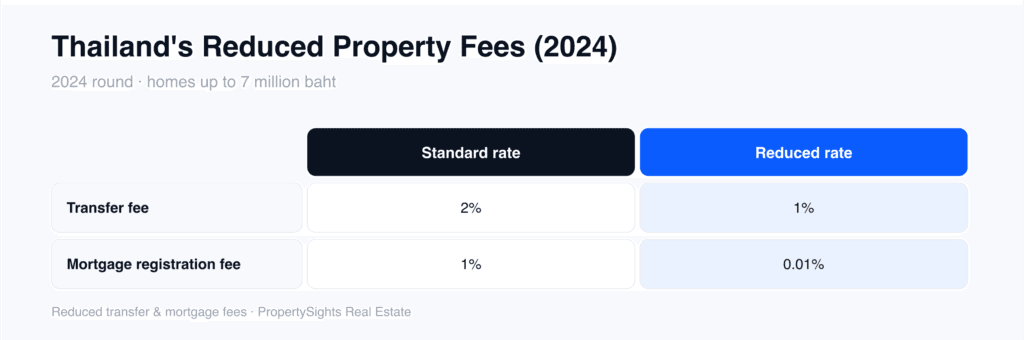
Thailand's reduced property fees: a table comparing the standard and reduced 2024 rates — the transfer fee cut from 2% to 1% of the appraised or sale value and the mortgage registration fee from 1% to 0.01% for eligible homes up to 7 million baht.
The 2024 round cut the transfer fee to 1% and the mortgage registration fee to 0.01%.

The policy affects Thai property and tax law in two main ways:

  • Transfer fees are reduced from 2% to 1% of the appraised or sales value of the property (whichever is higher).
  • Registration fees for mortgages are reduced from 1% to 0.01%.

For the full picture of what is normally owed, see our breakdown of the taxes on a property transaction and our step-by-step guide to transferring property ownership.

Who Qualifies for the Fee Reduction?
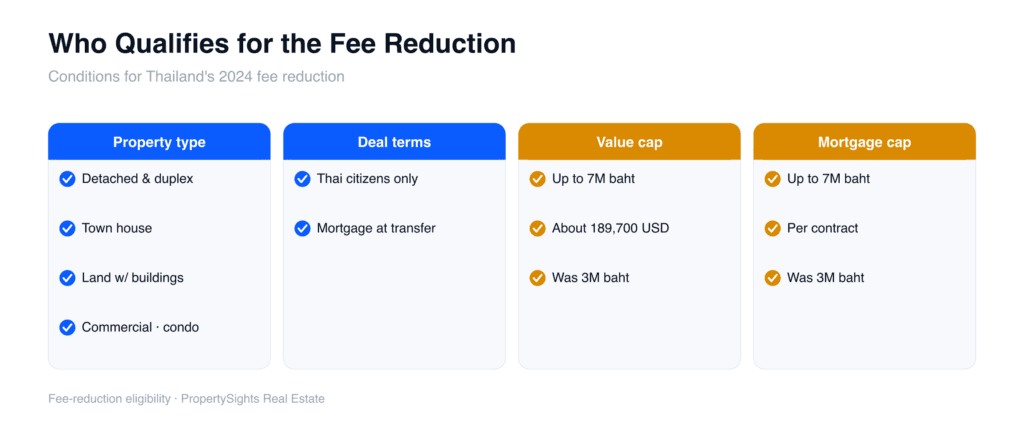
Thailand fee-reduction eligibility: a checklist of who qualifies — eligible property types (detached, duplex, town house, land with buildings, commercial and condominiums), Thai-citizen buyers only, the mortgage registered at the same time as the transfer, and a 7 million baht cap on both the property value and each mortgage contract.
Who qualifies for Thailand’s 2024 fee reduction — property type, buyer, and the 7 million baht caps.

The following conditions apply to these fee reductions:

  • Only these categories of immovable property are authorized: detached houses, duplexes, town houses, land with buildings, commercial buildings, and condominiums (new and second-hand).
  • Only sales to Thai citizens are eligible.
  • The mortgage must be registered at the same time as the property transfer to qualify for the mortgage registration fee reduction.
  • The value of the transferred property must not exceed 7 million baht (about 189,700 USD as of April 2024), up from the previous 3 million baht.
  • Each mortgage contract must not exceed 7 million baht, also up from the previous 3 million baht.

The original reduction of mortgage and property transfer fees began on 18 January 2022 to make real estate more affordable and boost the market. The 2024 extension was set to run to 31 December 2024; similar measures have been renewed in later rounds, so check the latest cabinet resolution for current dates and thresholds.

How Can Foreigners Benefit?

These rules target Thai citizens, but foreigners can still benefit in two ways.

The first is through increased demand. A reduction in fees makes property more attractive to Thai buyers, widening the pool of buyers, which can in turn raise the value of offers a foreign owner receives when selling.

The second is on the transfer fee itself. When transferring property in Thailand, the buyer is often responsible for the transfer fee, but the seller sometimes agrees to pay a portion. Reduced fees make this a more attractive tool to leverage in sales negotiations. New foreign buyers can read our guide to buying a first home in Thailand for the wider cost picture.

Is There a Construction Tax Deduction?

In addition to the reduced transfer and mortgage registration fees, a tax deduction of 10,000 baht per 1 million baht of construction costs was available for payments on contracts beginning and concluding within a window of 9 April 2024 to 31 December 2025, up to a maximum deduction of 100,000 baht.

Though such measures shrink the Kingdom’s tax revenue, the government estimated the policy would raise overall GDP by about 0.5%, driven by more construction projects and supply-chain activity such as sales of lumber, steel, concrete and interior finishing.

Let Our Bangkok Property Experts Help

Almost done — how can we reach you?

Get a Free Consultation with PropertySights

Would you like a free real estate consultation from our experts?


About the author

Jirapol B.

Jirapol B.

Content Editor

Writes and edits PropertySights' guides to buying, renting and owning Bangkok property

More about Jirapol B.Meet the whole team

Frequently asked questions

How much are Thailand's reduced transfer and mortgage fees?
Under the 2024 reduction, the property transfer fee was cut from 2% to 1% of the appraised or sale value, whichever is higher, and the mortgage registration fee was cut from 1% to 0.01%. These rates apply to eligible properties valued up to 7 million baht. Because such measures are renewed periodically, always confirm the current rate and expiry with the Land Department.
Who qualifies for the reduced property fees in Thailand?
Eligibility is limited to detached houses, duplexes, townhouses, land with buildings, commercial buildings and condominiums (new or second-hand). Only sales to Thai citizens qualify, the property value and each mortgage contract must not exceed 7 million baht, and the mortgage must be registered at the same time as the transfer to get the mortgage fee reduction.
Can foreigners benefit from the fee reduction?
Although the reduced fees apply only to sales to Thai citizens, foreigners benefit indirectly. Lower fees make property more attractive to Thai buyers, widening the buyer pool and supporting resale values. Foreigners can also use the reduced transfer fee as leverage in negotiations, since the buyer usually pays it and a seller may agree to share the cost.
Is there a construction tax deduction in Thailand?
Yes. Alongside the fee cuts, a tax deduction of 10,000 baht per 1 million baht of construction cost was available for contracts starting and finishing between 9 April 2024 and 31 December 2025, capped at 100,000 baht. It was aimed at encouraging building activity, which the government estimated could lift GDP by around 0.5%.
What is the maximum property value for the reduced fees?
The 2024 reduction applied to properties valued up to 7 million baht, raised from the previous 3 million baht cap, and each mortgage contract was also capped at 7 million baht. Properties above that value pay the standard 2% transfer fee and 1% mortgage registration fee. Check the latest cabinet resolution, as thresholds change between rounds.

Related guides — Buying Property in Bangkok

High-rise condominium under construction in Bangkok with a tower crane, the stage at which off-plan units are soldBuying Property in Bangkok
Oct 13, 2026

What Is an Off-Plan Condo? Buying in Thailand

Learn what off-plan condos mean in Thailand, how pre-construction purchases work, the legal protections and risks, and what buyers should check before paying.

Infinity pool on a Bangkok condominium rooftop looking out over the Sukhumvit skyline, the kind of top-floor amenity penthouses are sold onBuying Property in Bangkok
Oct 13, 2026

What Is a Penthouse? Features, Legal Status & Bangkok Buying Tips

What is a penthouse in Bangkok? Learn how it differs from a duplex, loft and sky villa, what foreign buyers should check, and how to assess the premium.

A row of attached townhouses with individual front doors and driveways, the row-house form Thai law calls baan thaewBuying Property in Bangkok
Oct 13, 2026

Townhouse vs Twin House in Thailand: Key Differences

Townhouse vs twin house in Thailand explained: legal definitions, layout differences, building rules and what foreign buyers should check.

Curved internal staircase linking the two levels of a duplex apartment, seen from the upper floorBuying Property in Bangkok
Oct 12, 2026

Duplex vs Loft Condo in Bangkok: Key Differences

Duplex or loft condo in Bangkok? Compare the layouts, understand how registered area affects price and ownership checks, and see what to inspect before buying or renting.

Looking up at the balconies of a Bangkok condominium tower whose common areas are funded by owners' feesBuying Property in Bangkok
Oct 12, 2026

Condo Common Area Fee vs Sinking Fund in Thailand

Understand condo common-area fees and sinking funds in Thailand, what the Condominium Act says, and which documents to check before buying a new or resale unit in Bangkok.

ผู้ซื้อคอนโดตรวจเอกสารทะเบียนบ้านและสัญญาก่อนย้ายชื่อเข้าทะเบียนบ้านคอนโดBuying Property in Bangkok
Aug 31, 2026

Does a Bangkok Condo Come With a Tabien Baan — and Must You Move Into It?

Every condo unit already has its own house-registration book, and you receive it at transfer. Moving your name into it is optional and does not affect ownership — but one year of registration switches the tax you pay on sale from 3.3% to 0.5%.