

PropertySights
Home/Buying Property in Bangkok/Buying a Condo in Bangkok as a Foreigner: 2026 Guide

Buying a Condo in Bangkok as a Foreigner: 2026 Guide

Published: July 13, 2026Jirapol B.Written by Jirapol B.Buying Property in Bangkok
Updated on August 6, 2026
Bangkok condominium skyline with high-rise towers, illustrating buying a condo in Bangkok as a foreigner


A foreigner can buy a condominium in Bangkok freehold — owned outright in their own name — as long as foreign buyers hold no more than 49% of the building’s total floor area. A Bangkok condo is the only property a foreigner can own directly (land and houses cannot be), which is why the city’s central, transit-connected condo market is built around overseas buyers. Prices range from around ฿95,000 per square metre in outer districts to over ฿340,000 in prime areas like Ploen Chit and Asoke.

This guide is the Bangkok-specific companion to our broader articles on whether foreigners can buy property in Thailand and how to buy property in Thailand step by step. Here we focus on what matters for a Bangkok condo in particular: the best districts, real price bands by area, how the foreign quota works at the building level, and how to move from research to a shortlist. When you are ready, browse Bangkok condos for sale within foreign quota.

Why a condo is the right choice for foreigners in Bangkok

Thai law lets a foreigner own a condominium unit freehold, but not land — so a house, townhouse or villa cannot be held in a foreigner’s own name, only through a lease, a company, or a Thai spouse. In a dense, vertical city like Bangkok this is rarely a limitation: the most desirable homes and the strongest rental performers are condos near a BTS or MRT station, and those are exactly what a foreigner can own outright. Buying a Bangkok condo therefore gives you the securest form of ownership, a liquid resale market, and the city’s best rental demand, all in one. For the full legal comparison of freehold versus leasehold and the other routes, see our foreign ownership guide.

How the 49% foreign quota works in a Bangkok building
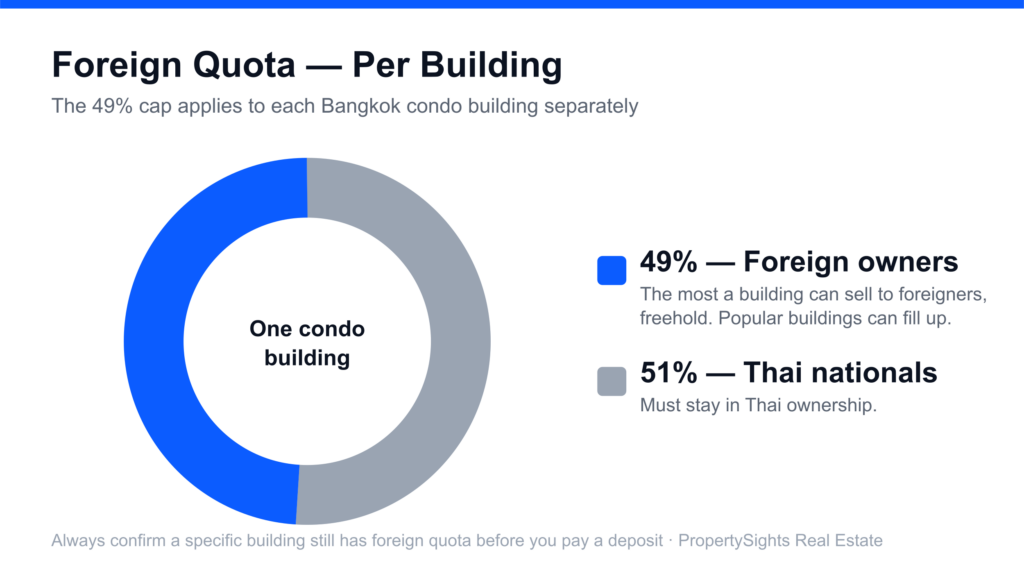
Diagram showing how the 49% foreign ownership quota applies at the building level for a Bangkok condominium
The 49% foreign quota is measured across each building’s total floor area — always confirm a specific building still has quota before you buy.

The quota is not a national cap — it applies building by building. In any one condominium, foreigners may collectively own up to 49% of the total saleable floor area; the remaining 51% must stay in Thai hands. This has a practical consequence in Bangkok: popular international-facing buildings in Sukhumvit and along the river can reach their foreign limit, so a unit you like may only be available on the Thai-quota side (which a foreigner cannot buy freehold) or on leasehold. Before you commit, the developer or your agent confirms in writing that the building still has foreign freehold quota available for your specific unit — a check we run on every Bangkok condo we handle. If the freehold quota is full, the same unit can often still be secured on a registered 30-year leasehold instead.

Where to buy: Bangkok districts for foreign condo buyers
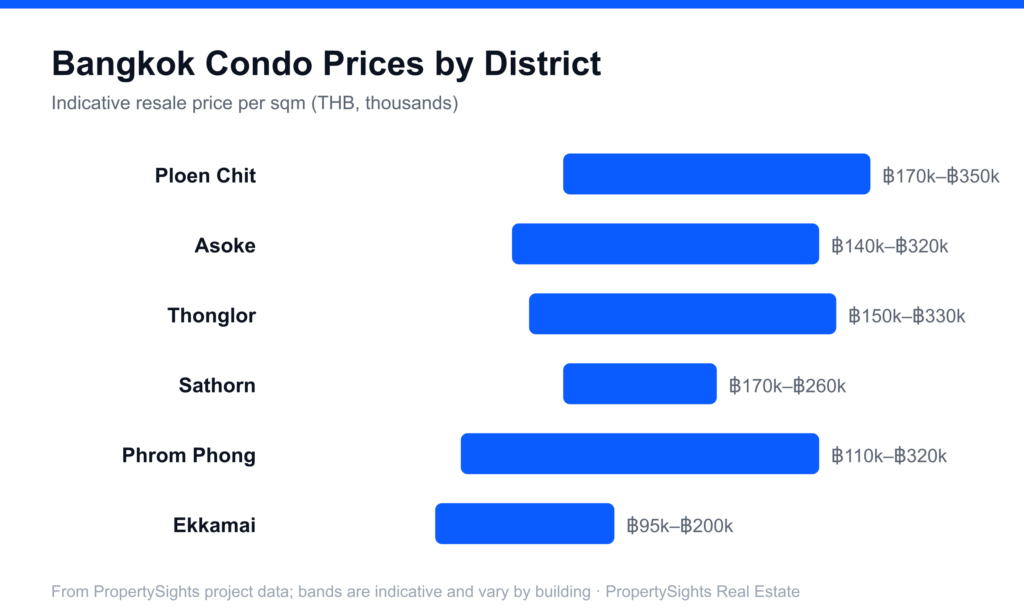
Diagram of indicative Bangkok condo prices per square metre by district for foreign buyers, from Ekkamai to Ploen Chit
Indicative resale price bands per square metre across popular central Bangkok districts (from PropertySights project data).

Location drives both lifestyle and resale value, and the central, BTS/MRT-connected districts are where foreign demand — and therefore liquidity — concentrates. The bands below are indicative resale prices per square metre drawn from our own project data.

Ploen Chit / Chidlom ~฿170,000–฿350,000/sqm — the prime CBD, directly on the BTS, luxury and international brands.
Asoke (Sukhumvit) ~฿140,000–฿320,000/sqm — the interchange hub (BTS + MRT), strong rental demand from expats.
Thonglor ~฿150,000–฿330,000/sqm — trendy dining and nightlife, popular with young professionals.
Sathorn ~฿170,000–฿260,000/sqm — the financial district, riverside views, established demand.
Phrom Phong ~฿110,000–฿320,000/sqm — family-friendly, malls and international schools nearby.
Ekkamai ~฿95,000–฿200,000/sqm — a more accessible entry point on the Sukhumvit line.

Browse live listings and price comparisons on our area hubs, for example condos for sale in Asoke, Thonglor, Sathorn and Phrom Phong. Whichever district you choose, proximity to a BTS or MRT station is the single strongest driver of both resale value and rental yield.

A quick way to match a district to your purpose: Ploen Chit and Chidlom are the prestige core, best for buyers who want a trophy address on the BTS and are less price-sensitive. Asoke is the connectivity king — the BTS–MRT interchange makes it the deepest rental market in the city, ideal for an investor who wants a unit that rarely sits empty. Thonglor and Ekkamai attract a younger, lifestyle-driven crowd and many Japanese expats, so furnished one-bedrooms rent quickly there. Phrom Phong suits families, with EmQuartier and international schools nearby, which supports demand for larger two-bedroom units. Sathorn is the business-district and riverside choice, favoured by professionals who want a short walk to the office or a river view. Matching the unit type to the district’s typical tenant — studios and one-beds in Asoke and Thonglor, two-beds in Phrom Phong and Sathorn — is what separates a unit that rents easily from one that lingers.

New off-plan versus resale in Bangkok

Both routes are open to foreigners, and the choice affects price, timing and quota. New units bought from a developer come with a fresh building, modern facilities, a clear foreign-quota allocation, and — for off-plan projects — the option to pay in instalments during construction; the trade-off is that you may buy before you can see the finished unit and view. Resale units let you inspect the exact condition, the real view and the building’s actual management standard, and they are often in the mature central locations where new land has run out — but they need closer due diligence on outstanding common-area fees and the unit’s history. In prime Bangkok districts most foreign purchases are resale, simply because the best-located buildings are already built. Our guide to how to buy property in Thailand walks through the mechanics that apply to both.

What it costs to buy a condo in Bangkok

Beyond the unit price, budget for transaction costs at the Land Office — typically a few per cent of the value and often split with the seller. The main items are the transfer fee (2% of appraised value), specific business tax (3.3%) or stamp duty (0.5%) depending on how long the seller has owned, withholding tax (the seller’s cost), and, if you finance, a 1% mortgage-registration fee. Add roughly 0.5–1% for independent legal due diligence. For the full breakdown and who pays each item, see our guide to how to buy property in Thailand, and for ongoing charges our Thailand property tax guide.

Bringing your money in: the FET requirement

To register foreign freehold ownership of a Bangkok condo, the purchase funds must enter Thailand in foreign currency and be converted to baht by a Thai bank, which issues a Foreign Exchange Transaction (FET) form. The Land Office requires this document at transfer as proof the money came from abroad. Send the funds in your own name, note that they are for buying a specific condominium, and collect the FET before transfer day — this is the paperwork that most often delays a foreign purchase, so plan it early.

Get a Free Consultation with PropertySights

Would you like a free real estate consultation from our experts?

Can foreigners get a mortgage for a Bangkok condo?

Most foreign buyers pay cash brought in from overseas, because Thai retail banks generally do not lend to non-resident foreigners. That said, financing is possible: the international arms of Thai banks (through Singapore and Hong Kong), a few specialist cross-border lenders, and developer instalment plans during construction. Typical terms are 50–70% loan-to-value with proof of income. If you intend to finance, arrange approval in principle before you commit, and read our mortgage and home-loan guide for the detail.

The buying process in brief

The Bangkok condo purchase follows the same seven steps as any Thai property purchase: choose the unit and confirm foreign quota, engage an independent lawyer for due diligence, sign the reservation agreement and pay a deposit, sign the Sale and Purchase Agreement, transfer your funds and obtain the FET, prepare the transfer costs, and register ownership at the Land Office. Each step is covered in depth in our step-by-step buying guide — the one thing to add for Bangkok is the building-level quota check, which should happen before you pay any deposit.

Is a Bangkok condo a good investment for a foreigner?

For many overseas buyers, yes — but the return depends on choosing the right unit, not just the right country. Central Bangkok condos near a BTS or MRT station typically produce gross rental yields of around 4–5%, higher than prime property in most Western capitals, driven by a large and stable expat and professional rental pool. Capital growth is steadier than spectacular: well-located, well-managed buildings hold value and appreciate gradually, while oversupplied fringe locations can stagnate. The levers that matter most are the same ones that make a unit rentable — walking distance to a station, a reputable developer and juristic person, and a unit type that suits the district’s tenants. Currency is a factor too: because you bring funds in as foreign currency and can repatriate the sale proceeds (with your FET), exchange-rate movements affect your real return. For a fuller framework, read our property investment guide and the condo versus house comparison before you commit.

How long does it take to buy a condo in Bangkok?

A cash purchase of a completed resale condo typically completes in about two to four weeks, paced mainly by how quickly the due diligence is finished and your funds arrive from abroad. Financing lengthens this to roughly six to eight weeks while the bank appraises and approves the loan. Off-plan purchases are different again: you reserve and pay a deposit now, then transfer only when the building completes, which can be months or years away. In every case the international fund transfer and the FET are the steps most likely to cause delay, so start them early rather than leaving them to the final week.

Owning a Bangkok condo: what to expect after you buy

Once the unit is yours, a few ongoing costs and duties apply. You pay a monthly or annual common-area maintenance fee to the building’s juristic person, charged per square metre, plus a one-off sinking-fund contribution for major repairs. There is a modest annual land-and-building tax on the owner. If you let the unit, the rental income is taxable in Thailand and you should keep records from the start — see our Thailand property tax guide. Keep your title deed, FET form and Sale and Purchase Agreement together in a safe place: you will need the FET in particular if you later sell and want to send the proceeds back out of Thailand, as it proves the original funds came from abroad. Reselling a well-located, quota-clean Bangkok condo is generally straightforward, which is one of the main reasons the central districts hold their value.

Buying to live in versus to invest

If you are buying to live in, weigh the unit’s layout, floor, light and your daily commute most heavily. If you are buying to invest and rent, prioritise the fundamentals that drive Bangkok yields: a station within a few minutes’ walk, a building with proven rental demand and professional management, and a unit type that lets easily — compact one-bedrooms and studios in Asoke, Phrom Phong and Thonglor turn over fastest. Gross rental yields in the central districts typically run around 4–5%. For a deeper investment view, see our property investment guide, then shortlist from Bangkok condos for sale.

Common pitfalls to avoid in Bangkok

The avoidable mistakes are specific and consistent: paying a deposit before confirming the building has foreign freehold quota for your unit; skipping independent legal due diligence and relying on the seller’s paperwork; ignoring the FET and being blocked at transfer; overlooking outstanding common-area fees that transfer with the unit; and chasing a headline price far from a station, which hurts both resale and rental. Engaging a lawyer early and running the quota check first removes almost all of this risk. When you are ready to move from research to shortlisting, browse Bangkok condos for sale or ask our team to check a specific building’s quota for you.

Frequently asked questions


Planning to Invest in Bangkok Property?

What is your budget?

About the author

Jirapol B.

Jirapol B.

Content Editor

Writes and edits PropertySights' guides to buying, renting and owning Bangkok property

Meet the whole team

Frequently asked questions

Can a foreigner buy a condo in Bangkok?
Yes. A foreigner can own a Bangkok condominium unit freehold, in their own name, provided foreign owners hold no more than 49% of the building's total floor area. A condo is the only property a foreigner can own directly in Thailand, which makes Bangkok's central condo market the standard route for overseas buyers.
How much does a condo in Bangkok cost for a foreigner?
Indicative resale prices range from about ฿95,000 per square metre in more accessible districts like Ekkamai to ฿170,000–฿350,000 in prime areas such as Ploen Chit, Asoke and Sathorn. On top of the unit price, budget a few per cent for transfer taxes, fees and legal due diligence.
What is the best area to buy a condo in Bangkok?
The most liquid, rentable areas are the central BTS/MRT districts: Ploen Chit and Asoke for the prime CBD, Thonglor and Phrom Phong for lifestyle and families, and Sathorn for the financial district and riverside. Ekkamai offers a more accessible entry point. Proximity to a station is the strongest driver of value and yield.
How do I check if a Bangkok building has foreign quota available?
The 49% foreign quota is measured per building, so you must confirm it for the specific building before buying. The developer or the condominium's juristic person can state the current foreign-owned percentage in writing; a good agent obtains this confirmation before you pay any deposit. If freehold quota is full, the unit can often be bought on a 30-year leasehold instead.
Do I need to bring money from abroad to buy a Bangkok condo?
Yes. To register foreign freehold ownership, the purchase funds must enter Thailand in foreign currency and be converted to baht by a Thai bank, which issues a Foreign Exchange Transaction (FET) form. The Land Office requires the FET at transfer as proof the money originated overseas.

Related guides — Buying Property in Bangkok

Buying Property in Bangkok
Aug 31, 2026

Does a Bangkok Condo Come With a Tabien Baan — and Must You Move Into It?

Every condo unit already has its own house-registration book, and you receive it at transfer. Moving your name into it is optional and does not affect ownership — but one year of registration switches the tax you pay on sale from 3.3% to 0.5%.

Buying Property in Bangkok
Aug 31, 2026

Selling a Bangkok Condo That Still Has a Mortgage on It

You do not have to clear the loan before you sell. The mortgage is redeemed out of the buyer’s payment at the Land Office on transfer day, and the balance goes to you. The number that decides everything is the bank’s payoff figure — and if the sale price falls short of it, the seller makes up the difference in cash.

ห้องคอนโดใหม่ที่ว่างเปล่า ตัวอย่างห้องที่ต้องตรวจรับก่อนโอนกรรมสิทธิ์Buying Property in Bangkok
Jul 19, 2026

Condo Handover Inspection in Thailand: A 20-Point DIY Checklist

How to inspect a new condo for defects before you accept transfer — the tools to bring, a 20-point checklist (floors, walls, bathroom, wiring, water, meters), and how to make the developer fix them first.

ล็อบบี้คอนโดที่ดูแลโดยนิติบุคคลอาคารชุด ตัวอย่างทรัพย์ส่วนกลางที่นิติบุคคลบริหารBuying Property in Bangkok
Jul 19, 2026

The Condo Juristic Person in Thailand: Duties, Powers & Your Rights

What the condo juristic person (นิติบุคคลอาคารชุด) is, how it’s structured (manager, committee, general meeting), its duties and powers under the Condominium Act, and how co-owners can hold it to account.

อาคารคอนโดมิเนียมสูงในเมือง ตัวอย่างคอนโดที่ผู้ซื้อกู้ธนาคารเพื่อซื้อBuying Property in Bangkok
Jul 18, 2026

Getting a Condo Loan in Thailand: How Much You Can Borrow

How condo mortgages work in Thailand — LTV limits, how much you can borrow on your income, an instalment table, the documents banks require, and what to do if your loan is rejected.

อาคารคอนโดมิเนียมที่กำลังก่อสร้าง ตัวอย่างคอนโดที่ขายดาวน์ได้ก่อนสร้างเสร็จBuying Property in Bangkok
Jul 18, 2026

Selling a Condo Down-Payment (Pre-Completion) in Thailand

How to sell a pre-completion condo contract (ขายดาวน์) — the developer contract-transfer steps, tax on the profit, and how it differs from selling a booking (ขายใบจอง) or a completed unit (ขายโอน).