

PropertySights
Home/Foreigner Ownership & Legal/Thailand House Registration (Tabien Baan): The Blue Book & Yellow Book Guide

Thailand House Registration (Tabien Baan): The Blue Book & Yellow Book Guide

Published: August 20, 2025Foreigner Ownership & Legal
Updated on July 1, 2026
Info About the Real Estate House Registration in Thailand

A house registration book, or Tabian Baan, is the official Thai record of who is registered as living at a property. Thai nationals hold a blue book and eligible foreigners a yellow book (Tor.Ror.13). Foreigners who hold land do so through a Thai limited company. It does not prove ownership — only a title deed does — but it is needed for residence, utilities and tax benefits, and is part of buying a home.

The process to register yourself in a Tabien Baan, or house registration book, is simpler than you might think and it can make your life in the Land of Smiles easier. Learn all about the types, benefits, and application process in this article by PropertySights Real Estate.

Buying a home in Thailand? Your name goes into the house registration book (tabien baan) when you complete a purchase — see our guides to Chanote title deeds and transferring property ownership, or browse condos for sale in Bangkok.

What Is a House Registration Book in Thailand?

Unlike a Chanote title deed, the Tabian Baan does not prove ownership and cannot back a home loan. It is separate from the TM30 residence notification.

A house registration book, also known as Tabien Baan, is an official government record of registered homeowners and residents associated with a property. It’s a small handbook with several pages providing details on such residents.

The front page of a Tabien Baan shows the full address and type of residence (either condominium or house).

Page two contains the details of the house holder who may or may not actually own the house. These details include full name, nationality, date of birth, and 13-digit citizen ID number.

The next pages contain the information of other occupants registered to that address.

The yellow and blue book house registrations are the most common, but there are several other types that apply to different residences and property statuses.

What Types of Tabien Baan Are There?
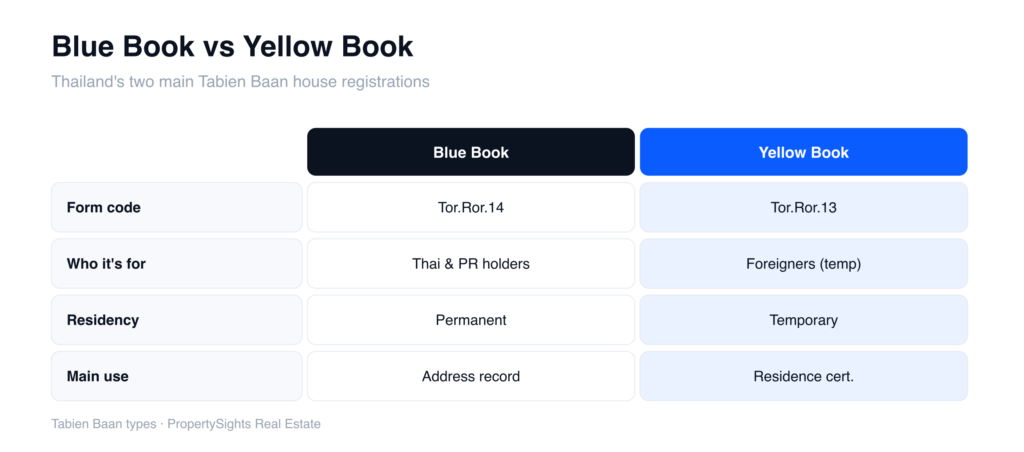
There are a total of five types of Tabien Baan:

  • Blue book house registration (Thr. Ror. 14). For listing the names of Thai nationals and foreigners with permanent residency as a resident of a house.
  • Yellow book house registration (Thr. Ror. 13). For listing the names of temporary residents (non-immigration visas) as a resident of a house.
  • Temporary house registration. For temporarily registering names to a house that was constructed without permission according to the Building Control Act of Thailand or a house built in a reserved forest area. In theory, residents would apply for a regular blue or yellow book registration once a building permit is granted.
  • Temporary house registration from the registry office. Used to request temporary removal from a registry when traveling abroad.
  • Central house registration. Used in cases where the applicant cannot be properly registered to a house.

What Are the Benefits of a Yellow House Registration Book for Foreigners in Thailand?

The first benefit of the yellow house registration book is with regards to the Specific Business Tax (SBT) of 3.3% that normally applies to transfers of property. This charge doesn’t apply to private individuals under Thailand’s tax and property law as long as the piece of property in question has been registered as your main address for at least 1 year.

The next benefit is that a yellow Tabien Baan can be used to retrieve an official certificate of residence. This gives you the right as a foreigner to complete several legal transactions:

  • Obtaining a pink alien ID card
  • Obtaining a Thai driver’s license
  • Purchasing automobiles
  • Opening a Thai bank account
  • Setting up internet or SIM card accounts
  • Drawing up legal documents
  • Applying for PR (permanent residence) or citizenship

What Criteria Must Foreigners Fulfill To Obtain the Yellow Book (Tor.Ror.13)?

Under Section 38 of the Civil Registration Act B.E. 1991, foreigners can obtain the yellow house registration book (Tor.Ror.13) as long as they’re in Thailand on a non-immigrant visa and are temporary residents. This also applies to the children of such people born in Thailand.

Generally there are two cases in which foreigners would be able to apply for this document. First, if they’re married to a Thai national, and second, if they’ve purchased and have ownership rights to a property in Thailand.

The less common situation for yellow book applicants is getting permission from a separate home owner. This can be more complicated, involving an interview that must be passed and a potentially longer list of documents required by the district officer.

How to Apply for Yellow Book for Foreigners – Documents and Conditions

Before putting together an application for a Tabien Baan, you should check with your Amphoe (district) or Thesaban (municipality) office as different areas sometimes require different documents. In general, you can expect the following to be required:

  • Land title deed
  • Construction permit
  • Official sale or lease agreement
  • Other documents related to the land
  • Homeowners ID (original)
  • Home owner’s house registration with a separate copy
  • ID card of the homeowner
  • Passport and visa (original)
  • Official translation of passport and visa certified by Thai consulate
  • Work permit (if applicable)
  • 2 passport-style photos (1.5 inch size)
  • Marriage certificate for those married to a Thai national
  • Spouse’s ID card (original)
  • Child’s birth certificate (in the case of children)
  • Power of attorney in cases when not applying in person

An important condition is that there must also be 2 Thai witnesses present when submitting the application with their own Thai ID cards and Tabien Baan. In addition, several copies of documents may need to be signed, such as the marriage certificate.

What Are the Steps When Applying for the Yellow Book as a Foreigner?
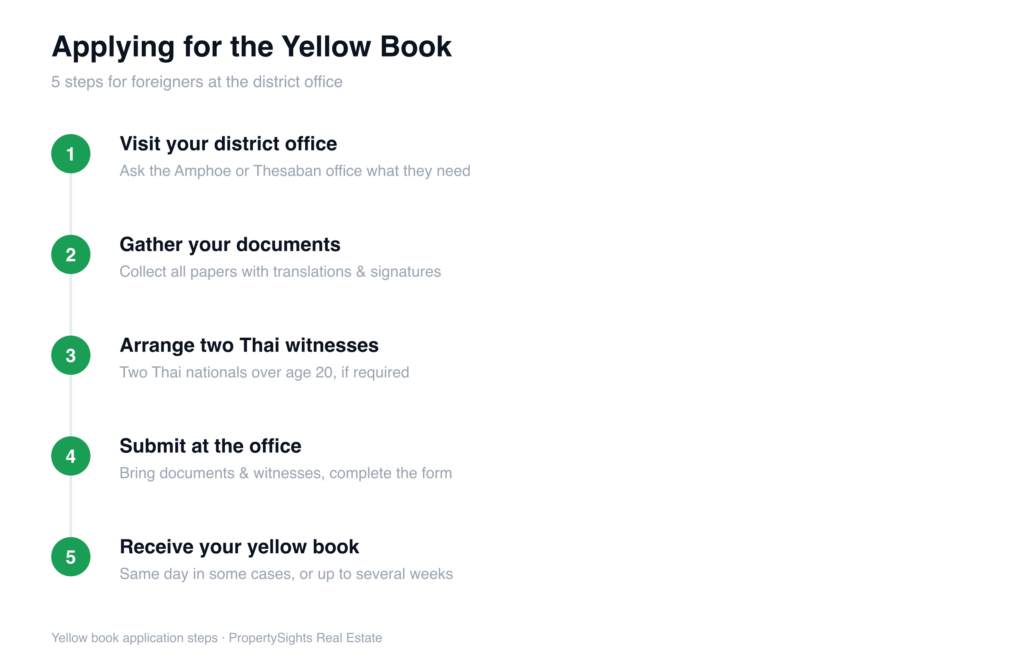
When working toward obtaining a yellow house registration book, proceed in the following order:

  1. Visit the local Amphoe (district) or Thesaban (municipality) office that your property is located in and enquire about what documents and conditions they require for the application. Each area may differ slightly.
  2. Gather all documents with translations and signatures where necessary.
  3. Arrange for two Thai nationals over the age of 20 to accompany you to the office if required by the office you’re applying to.
  4. Take all necessary documents and witnesses to the office and complete application.
  5. Wait to receive your yellow book. It may be available the same day, but it can also take several weeks in some cases.

How Do You Add Names to the Yellow Book House Registration?

Names of dependents who are temporary visitors or on non-immigrant visas can be added to the yellow book house registration the same way the book is created in the first place. First, the dependent will need to visit the local Amphoe or Thesaban office to confirm the documents and procedures. After following the necessary steps and submitting the documents, it’s a matter of waiting for confirmation.

Let Our Bangkok Property Experts Help

Almost done — how can we reach you?

What Are the Benefits of Obtaining the Blue House Registration Book for Thai Nationals?

The benefit of obtaining the blue house registration book (Tor.Ror.14) for Thai nationals is that it serves as the official record of their address which makes several legal processes easier such as:

  • Loan applications
  • Registering for utilities
  • Large purchases such as cars
  • Bank account setup
  • Proving marriage status for future marriages
  • Proof of voting district
  • Defining child’s school district
  • And more

What Documents Are Required When Registering for a Blue Book?

When registering for a blue book, the following documents are required:

  • Land title deed
  • National Thai ID of the homeowner and of the applicant
  • Record of the property registered to the municipal office (document Tor.Ror.9)
  • Construction Permit
  • Photos of all sides of the property are also sometimes required

It’s best to check with the local municipality office to confirm which documents are required for the blue book.

Is It Possible To Transfer Your Principal Residence to a Different House Registration Book?

Yes, it’s possible to transfer your principal residence to a different house registration book. It’s best to start this process by contacting the municipal office associated with your new address.

What Are the Advantages of Moving Your Name to Another House Registration Book?

The main advantage of moving your name to a different house registration book is that Specific Business Tax (SBT) on the sale of that property won’t apply as long as you registered it as your main residence at least one year prior to selling. This applies to both the blue and the yellow book.

Another advantage to transferring blue house registration can be if you want to vote in a different municipality or district. It can also help smooth the process when changing your child’s schooling area.

How to Apply for a House Registration on a Property Purchased From a Developer

To apply for a house registration on a property purchased from a developer you’ll first need to receive the blank house book normally delivered after purchase of a new house or condo. You can take that along with the following to your local Amphoe (office district) for registration:

  • Original Sales and Purchase contract and copy
  • Original Title deed and copy
  • Mortgage contract and copy
  • Original ID card and copy
  • Copy of the original house registration (from the developer)
  • Power of attorney and copy of the grantor and attorney-in-fact’s ID where applicable

How Do You Change Your Name to a Different House Registration for a Property Purchased Second Hand?

You change your name to a different house registration for a property purchased second hand by using the previous owner’s Tabien Baan if they never registered themselves in it. If they did fix their name to the house registration, you’ll need to perform the house registration as usual, creating a new book listing yourself as the owner.

To complete the registration, ensure you have the following documents:

  • ID card (original and copy)
  • Your original house registration and a copy if you’re moving within the same district or municipality. If you’re switching to a different area, this isn’t necessary.
  • House registration of new property if available
  • Sales contract (original and copy)
  • Title deed (original and copy)
  • Power of attorney and copy of the grantor and attorney-in-fact’s ID where applicable

What Are the Steps to Apply for a Digital House Registration?

Thai nationals can apply for digital house registration via the ThaID app by following these steps.

  1. Download the ThaID app onto your iOS or Android device.
  2. Register yourself under first time use.
  3. Accept the terms and conditions, scan your ID, and take a picture of your face.
  4. Choose “selecting and certifying registration documents.”
  5. Choose “self-address change notification system.”
  6. Send request to host who must also have ThaID installed.
  7. Receive host’s consent which then sends a request to the appropriate office which will then notify you with the approval or rejection.

You can also select “self-register” to register your own property.

What Is the Difference Between the Host (Renter) And the Real Owner of the House?

In Thailand, the owner of a house is the person specified as having ownership rights in the land title deed, purchase agreement, and any other legal documents. The host is the head of the household who may or may not also be the owner. In other words, they could be a renter or tenant of the property.

When Is the Host Obligated To Report to the District Office?

According to the Civil Registration Act B.E. 1991, the host must report any births in a household within 30 days and any deaths within 24 hours. If they’re away for an extended period, they can also appoint a temporary host to fulfill these duties. Failure to do so can incur a fine of up to 1,000 Thai Baht.

Get a Free Consultation with PropertySights

Would you like a free real estate consultation from our experts?

Frequently asked questions

Does the Tabian Baan confirm property ownership?
No. The Tabian Baan, or house registration book, does not legally confirm ownership of a property. It may list the owner, but that is different from legal proof of ownership, which appears only on the land title deed (Chanote). The Tabian Baan records who is registered as resident at the address, not who owns it.
What is the difference between the yellow and blue house registration book?
The blue book (Tor.Ror.14) is for Thai nationals and permanent residents registered at a property, while the yellow book (Tor.Ror.13) is for eligible foreigners. The yellow book gives foreigners official proof of residence that helps with banking, driving licences and other administration. Each requires its own documents and application at the local district office.
Can a house registration book be used as mortgage collateral?
No. The house registration book cannot be used as collateral for a mortgage because it does not prove property ownership. Lenders require the land title deed (Chanote), which legally certifies ownership, as security for a home loan. The Tabian Baan only records residence and cannot stand in for the deed in any financing application.
How do foreigners get a yellow house registration book?
Eligible foreigners apply for the yellow book (Tor.Ror.13) at the local district office, providing a passport, visa, proof of address and supporting documents, often with a translation and verification. Criteria and exact paperwork vary by district. The yellow book then serves as official proof of residence, useful for everyday administration in Thailand.
What should you do if you lose your house registration book?
If you lose the house registration book, report it and apply for a replacement at the local district office that issued it, bringing your identification and any supporting property documents. The office can reissue the book from its records. Because the Tabian Baan is needed for residence and administration, replacing it promptly avoids complications with utilities or official processes.

Related guides — Foreigner Ownership & Legal

A couple relaxing in a bright modern Bangkok high-rise condominium with city skyline views, illustrating foreigners buying property in ThailandForeigner Ownership & Legal
Jul 10, 2026

Can Foreigners Buy Property in Thailand? (2026 Ownership Rules)

Yes — foreigners can own a Bangkok condo freehold within the 49% quota, but not land. A 2026 guide to freehold vs leasehold, the FET requirement, and ownership routes.

Smart Visa Program in ThailandForeigner Ownership & Legal
Apr 20, 2026

Smart Visa Program in Thailand: Complete Guide to Long-Term Residency

Thailand has become one of the most attractive destinations in Southeast Asia for professionals, investors, and entrepreneurs seeking long-term opportunities. The Smart Visa Program in Thailand was introduced to support this growth by offering a streamlined residency option for highly skilled individuals and business contributors. Designed to attract global talent, the program aligns with Thailand’s […]

Thai visa stamps in a passport, a key step for those buying property in Bangkok and residency.Foreigner Ownership & Legal
Aug 20, 2025

Thai Residency Via Investment Visa and How to Obtain It

Thailand, known for its relaxed, low-cost lifestyle, offers a sure way to obtain Thai residency which is to have a minimum real estate investment of about $320,000. In this article, you will learn more about the conditions and requirements of this Investment Visa program.

Viewing authentic Thai Real Estate Title Deeds with government seals and property details.Foreigner Ownership & Legal
Aug 20, 2025

Chanote Title Deed in Thailand: A Guide for Foreign Property Buyers

All you need to know about Thailand land title deed or Chanote in Thailand for real estate, and the best tips to arrange it as well as the existing types

Real estate agent handing house model to senior couple; guide to Thailand inheritance law and taxForeigner Ownership & Legal
Aug 20, 2025

The Complete Guide to Inheritance Law and Tax in Thailand

Learn how succession for foreigners and Thai nationals works, the rules around property inheritance, and how tax applies to it all in this article by PropertySights Real Estate.

Official Thai immigration TM.30 form; a key document for maintaining residence for foreignersForeigner Ownership & Legal
Aug 20, 2025

Form TM30: Notification of Residence for Foreigners in Thailand

TM.30 form for notifying the government of foreign residents in Thailand. Learn what this law is for, who needs to fill it out, and how to do it in this article