



Transferring property ownership in Thailand is an 8-step process completed at the Land Department. It runs from title-deed due diligence and signing the sale and purchase agreement, through the deposit, the seller’s foreign-quota and debt-free certificates and the buyer’s Foreign Exchange Transaction (FET) form, to the handover where transfer fees and taxes are paid and the deed is registered in the new owner’s name.
Buying and selling property in Thailand as a foreigner as well as a local is a fairly common occurrence, especially in metropolitan destinations like Thailand. However, the process of transferring ownership of a property can be more complicated and confusing for local Thai people and foreigners. If this is your first purchase, read our guide to buying your first home in Thailand first, and sellers can follow our step-by-step guide to selling property.
8 Steps to Transfer Condo Freehold Ownership in Thailand
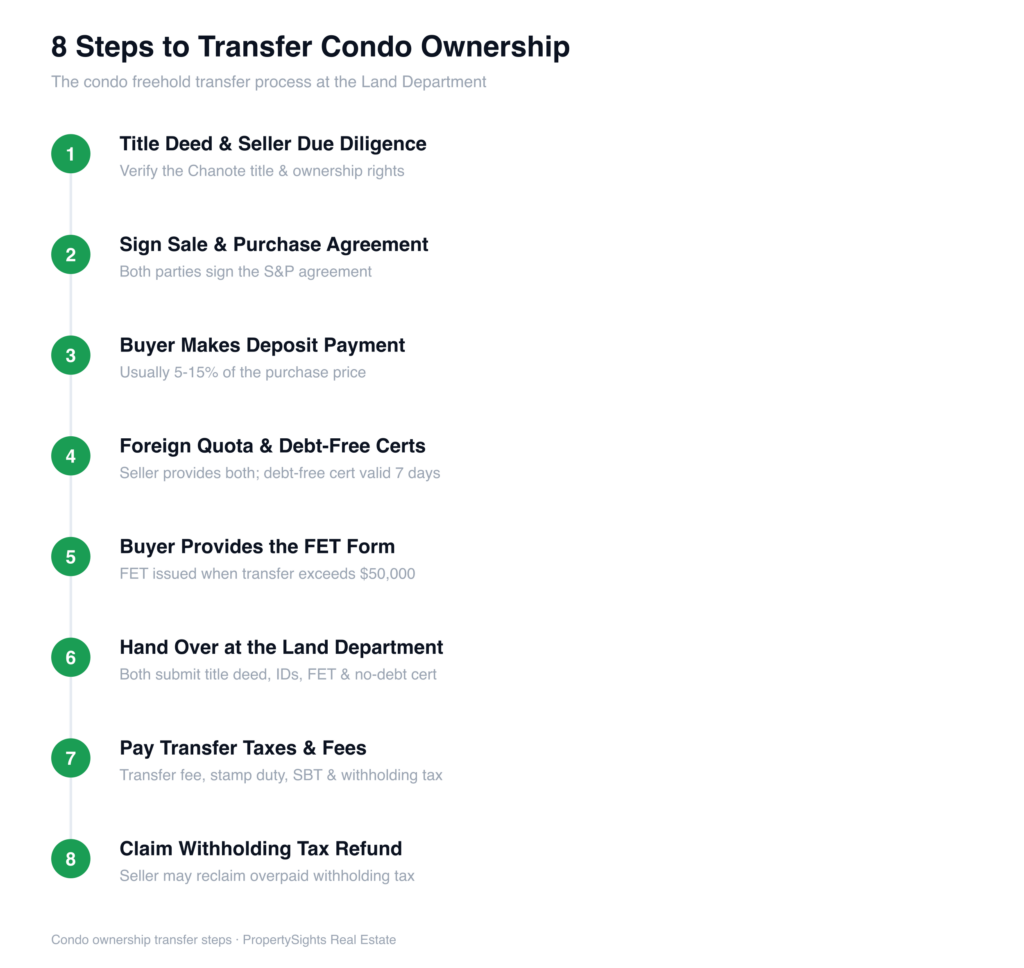
In order to make things clearer, we have put together an 8 step guide that explains how real estate ownership transfer works in Thailand.
1. Due Diligence of the Title Deed and the Seller
Due diligence of the title deed (also known as Chanote) and the seller is a process that involves scrutinizing and verifying the authenticity of the title deed and ownership rights to ensure that the property is free from any encumbrances or legal issues.
The title search is a crucial part since a defective title can lead to no transfer at all. The buyer must ensure that the owner is capable of transferring ownership and that there are no restrictions to the power of alienation of the owner.
It also serves to prevent fraud and to identify and evaluate all types of risks involved in investment and ensures that the investment is safe and secure.
2. Both Parties Signing of Agreement to Buy and Sell Property
Once the due diligence is complete, both parties must sign an agreement to purchase and sell the property. Here’s a general template of what a solid agreement should contain:
- The S&P agreement should identify the parties involved, the total purchase price, and the closing taxes fees costs.
- The sale and purchase agreement should outline the rights, duties, and responsibilities of both the seller and the buyer.
- The agreement should clearly and completely identify the property being sold, including the title deed and house registration, construction permit, or other required documentation (which will be cover later)
- The agreement should also specify the contents of the agreement, payment terms and schedule, legal obligations and protections, cancellation and breach of contract, and the role of a lawyer or legal advisor.
It’s recommended to have a property lawyer review the agreement before signing it to ensure that all information is accurate and up-to-date, and to prevent any errors or legal issues in the future.
3. The Buyer Makes Deposit Payment
When transferring condominium ownership in Thailand, it’s common practice for a buyer to make a deposit payment to secure the property. The deposit amount is usually between 5-15% of the purchase price of the property.
The deposit payment (sometimes referred to as booking deposit or booking fee) is made after the buyer has signed a reservation agreement and the payment is usually non-refundable, but this can be part of the negotiation terms between the parties.
4. The Seller Shall Provide the Foreign Quota and Debt-Free Certificates
When transferring condominium ownership in Thailand, the seller must provide the foreign quota and debt-free certificates to the buyer.
The foreign quota certificate is a document that states the number of units in a condominium building that can be sold to foreigners. Under Thai law, foreigners can only own up to 49% of the total floor space of any given condominium building in Thailand, while the other 51% must remain Thai-owned.
The debt-free certificate is a document that states that the property is free from any outstanding debts, such as unpaid water, electricity, and maintenance fees. The seller must request the debt-free certificate from the condominium juristic office and pay the relevant fees.
The processing time can take up to 15 days, depending on the regulations of a particular juristic office. After its issuance, the certificate is valid for 7 days before it expires.
5. The Buyer Shall Provide the FET From the Local Thai Bank
Foreign Exchange Transaction (FET) Form (Credit Advice) is a document issued by the handling bank that confirms the money sent into Thailand came from abroad. FET is only issued in cases where the transaction exceeds $50,000.
Here are 4 necessary steps of the transfer of funds along with FET below:
- The foreign buyer must transfer the funds electronically (wire transfer) from their overseas bank account in foreign currency to their local Thai bank account under the name of the buyer.
- The receiving bank will exchange it into Thai Baht (THB) when it reaches Thailand and shall issue the buyer with the FET document.
- The buyer must also provide proof of inbound transfer of funds from the issuing bank, and include the precise purpose of the transfer.
- In case of purchasing property directly from the developer, the full purchase price can be transferred to the developer’s bank account.
Should the transferred amount require the FET form, the document needs to be subsequently shown to the Land Department, during the property ownership transfer.
6. Required Documents From Both Parties at Hand Over in the Land Department
When transferring condominium ownership in Thailand, both parties must provide certain documents at the land department for the transfer of ownership. The required documents include:
- The original title deed of the property (Chanote)
- Certification of no-debt
- Copies plus original passports or ID documents of both parties
- Copies of immigration stamp in foreign party’s passport
- Company documents (within the last 3-month period)
- Foreign Exchange Transaction Certificate
Sometimes, required documents may vary depending on the type of property purchased and the specific circumstances of the transaction, and it is recommended to seek legal advice from a Thai lawyer.
What Types of Legal Statuses are Recognized in Thailand?
The legal statuses for transferring ownership of property in Thailand pertains to the personal status and recognized position or condition of an individual as outlined by the law. It encompasses facets, such as citizenship, marital status and the legal rights and obligations associated with it.
Knowing your status is important because it determines the documentation that will be required of you when transferring property ownership.
Here is a clarification of the different statuses requirements you must be aware as a foreigner buyer:
- Single status: refers to a person who has never been registered as married.
- Joint Ownership – Marital Status of a Married Foreign Couple: Couples of different or the same nationality (except for Thai nationality), who live together as a married couple, whether their marriage is legally registered in a foreign country or in Thailand, have the option to jointly purchase property. The couple buys the property together and it is jointly owned. Both individuals can provide a power of attorney to verify the transaction at the land department office on the transfer day.
- Joint Ownership – Marital Status of a Thai Citizen and a Foreign Citizen: Both buyers agree to buy property together, and the condo is jointly owned. The marriage can be registered either in Thailand or a foreign country. Both members can sign the power of attorney.
- Joint Ownership of Two or a Group of People – Non-Marital Status: Property ownership is shared between two or more people who are not spouses to one another. Unlike Thai nationals, there is no requirement for these owners to be related if they are foreign nationals. The property is jointly owned.
- Foreign Ownership – Marital Status of a Thai Citizen and a Foreign Citizen: In this case, the foreign national is the sole owner of the property. The property is foreign-owned and therefore counts towards the 49% foreigner quota. The buyer can only transfer funds from abroad, and is unable to make a purchase in THB (Thai Baht).
- Thai Ownership – Marital Status of a Thai Citizen and a Foreign Citizen: Similar to the previous one, but in this case the sole owner of the property is the Thai citizen. The payment can be made in THB and the transfer does not need to come from abroad.
What Documents for Property Ownership Transfer Are Required According to Your Legal Personal Status?
The table below outlines all the documentation needed depending on the status of the property buyer or buyers:
| Status | Documentation Needed |
| Single |
|
| Joint Ownership: Married Foreign Couple |
|
| Joint Ownership: Married Couple – Thai Citizen and Foreign Citizen |
|
| Joint Ownership: Non-Married People |
|
| Foreign Ownership: Married Couple – Thai Citizen and Foreign Citizen |
|
| Thai Ownership: Married Couple – Thai Citizen and Foreign Citizen |
|
7. The Taxes and Fees Involved When Transferring Property Ownership

In terms of property law and taxes in Thailand, there are several different taxes and fees involved (see our full breakdown of the taxes on a property transaction):
- The transfer fee is fixed at 2% of the property price, and the land office calculates this transfer fee from either the agreed sales price in the contract, or the price estimated by the land office (the higher price is chosen).
- The stamp duty is fixed at 0.5% of the property sale value at the time of purchase and at the transfer (land office). This only applies if the property was under the owner’s possession for longer than 5 years.
- The specific business tax is 3.3% over the registered (sale) value or appraised value (whichever is higher), and it is levied on companies and owners holding a property less than 5 years.
- The withholding tax is a prepayment of the property seller’s income tax, and it is nearly always paid by the seller. The rate of withholding tax ranges anywhere from 5-35%, and it varies depending on the length of time the seller has owned the property. The withholding tax is fixed at 1% in case the seller is a company.
8. Can I Claim Withholding Tax Refund as a Property Seller in Thailand?
A withholding tax can be looked at as an advance payment of (part of) the income tax. What this means is that the amount of withholding tax paid is automatically deducted from payable taxes at the year’s end.
However, in those cases where withholding tax is higher than the amount of tax, you may have a case for claiming a refund on the difference between the two.


