



Real estate appraisal in Thailand is the process of estimating a property’s market value, used by the Land Department to calculate transfer fees and taxes. The government appraised value is often lower than the true market price, so an independent appraisal by a Thai Valuers Association member gives buyers and sellers a more accurate figure before agreeing a price or transferring ownership.
Learn the Treasury Department’s real estate appraisal system in Thailand, the different value classifications, and assessment alternatives in this article by PropertySights Real Estate. Quality information is vital to any real estate transaction, and that starts with land appraisals. In Thailand there are different types, each with degrees of worth that can help you decide whether or not to pursue a piece of property.
What Is The Definition Of Real Estate Appraisal?
The definition of a real estate appraisal is a detailed report based on full investigation into the characteristics of a property and then forming an opinion on the value of that property.
The evaluation includes a survey of the land to determine its size and boundaries. It then weighs factors such as the attributes of the land, any structures on the property, the location, and the market conditions around the property to determine value.
What Is the Meaning of Land Appraisal Value in Thailand?
The meaning of land appraisal value in Thailand is the price attributed to a given property based on the government’s official assessment. This is carried out every 4 years by a combination of the Treasury Department and the Land Office.
Because the review is carried out so infrequently, the official land appraisal value can be out of step with the fair market value (FMV). This means that the value is used as a minimum in establishing property and transfer tax rates as well as Specific Business Tax (SBT) and Stamp Duty.
In the event of real estate transfers, hiring an independent land appraiser can be an alternative to the Treasury Department’s estimate. Independent appraisals can often provide a more accurate picture of the current FMV, which can make your purchasing decision more informed and possibly more profitable.
Why Is Property Appraisal in Thailand Important?
Property appraisal is important in Thailand because it influences taxation and financial reporting. Everyone from private owners, real estate developers and investors, and all the way to financial institutions like banks and the Thai stock market exchange require accurate estimates for their own accounting.
While the government’s assessed value can be useful to get a general view of property value trends, private evaluations are more accurate and may be the best route for institutions.
Planning to Invest in Bangkok Property?
What is your budget?
What Types of Property Value Classification Exist in Thailand?
There are 3 types of property value classification that exist in Thailand. They are:
- The assessed value. This refers to the land appraisal value as judged by the Thai government.
- The registered value. This is the value listed on land transfer documents associated with the property. Oftentimes the assessed value is the one used here.
- The market value. This is the true price paid for the property.
Why Do People Under-Report Transaction Prices at the Land Department in Thailand?
People under-report real estate transaction prices at the Land Department in Thailand to avoid paying a larger sum generated from taxes based on the sale price.
Depending on the circumstances this may include the Specific Business Tax (3.3% of actual sale or appraised value, whichever is higher), Stamp Duty (0.5% applied in absence of Specific Business Tax), Transfer fees (2%), and withholding tax (1%).
When transferring property ownership, sellers may be more motivated to pressure buyers into under-reporting the transaction price if they’re selling within 5 years and are subject to paying the Specific Business Tax.
Are There Legal Implications for Making False Statements at the Land Office?
Yes, there are legal implications for making false statements at the land office. Chapter 2, Section 37 of the Thai Revenue Code states that, “Any person who intentionally gives a false statement or evidence to evade taxes shall be subject to an imprisonment of 3 months to 7 years.”
In addition to the legal implications of the Revenue Code, Section 104 of the 1954 Land Code Act explicitly states that registration fees paid at the Krom Thee Din (Land Office) must be based on the true transaction amount.
What Are the Possible Financial Consequences of Under-Declaring a Price?
The possible financial consequences of under-declaring a property’s price are a fine from 2,000-200,000 Baht according to Section 37, paragraph 2 of the Thai Revenue Code.
Another financial consequence could come via more strict government enforcement of Thai property and tax law, and feeds the taxes on a property transaction and depends on the measured area of the property. If they were to crack down on false declarations, for example, you could find yourself selling a property at the true value after originally under-declaring. Because property appreciation is calculated as part of a progressive income tax up to 37%, this could lead to a larger tax burden in the end.
What Types of Real Estate Appraisal Prices Exist in Thailand?
There are 3 types of land appraisal prices that exist in Thailand, including Treasury Department appraisals, private appraisals, and the real market price.
The Treasury Department’s valuation can be further broken up into 3 categories:
- Land appraisals – the value of the land itself.
- Condominium appraisals – the value of a condominium.
- Building appraisals – the value of other buildings such as warehouses, docks, detached houses, hospitals, schools, and more.
Private appraisals are done by independent evaluators such as banks or realty services. The market price is the value that a buyer and seller have met at when transferring a property.
How to Estimate the Land Appraisal Price Online via the Land Department Website?
To estimate the land appraisal price online via the land department website, take the following steps:
- Have the title deed information ready in the case of a title deed search, the condominium name for a condo search, and the specific building type for a building search.
- Go to the Treasury Department appraisal site and click on the English option at the top right if you need it.
- From the top navigation bar, select either a deed, condo, or building assessment.
- Enter the necessary information into the input fields.
- In the case of a deed assessment, you’ll use the following information located at the top of the front title deed page: the Chanote number, the survey number, the province, and the district of the property.
- In the case of a condo assessment, you’ll need the province, district, and exact condo name.
- In the case of a building assessment, you’ll need the province and building type (in the Thai alphabet).
- Hit ‘search’ and wait. The results will eventually display title deed information, appraised prices, and a satellite image.
Who Is Responsible for Appraising Land Value in Thailand?
The Treasury Department’s Property Valuation Division is responsible for appraising land value in Thailand while the Land Office judges the value of structures and improvements made to the land.
This estimate is based on a specific calculation that takes into account factors such as the following:
- Size of the land
- Fair market value of surrounding properties
- Location and proximity to public transportation and utilities
- Condition and investment potential of structures
Estimated Treasury Department Land Appraisal Prices for Bangkok Main Roads in 2024
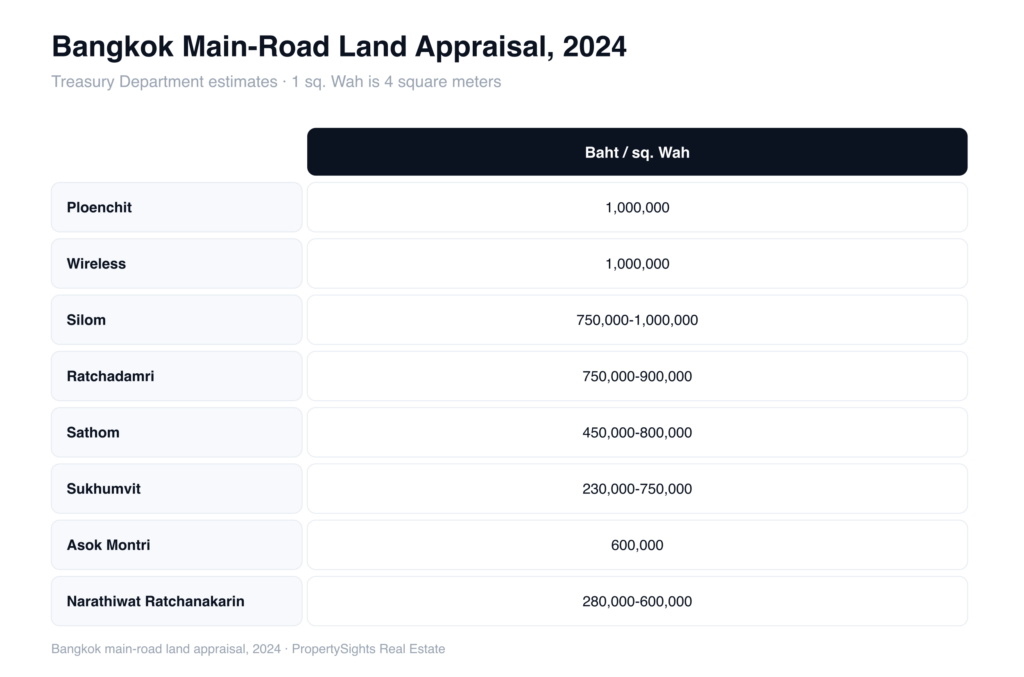
The estimated Treasury Department land appraisal prices for Bangkok main roads in 2024 are as follows:
| Road Name | Land Appraisal (Baht/sq. Wah) |
|---|---|
| Ploenchit | 1,000,000 |
| Wireless | 1,000,000 |
| Silom | 750,000-1,000,000 |
| Ratchadamri | 750,000-900,000 |
| Sathom | 450,000-800,000 |
| Sukhumvit | 230,000-750,000 |
| Asok Montri | 600,000 |
| Narathiwat Ratchanakarin | 280,000-600,000 |
Note: 1 sq. Wah = 4 square meters
What Are the Alternatives to Government Real Estate Appraisal?
The alternatives to real estate appraisals conducted by the government are private valuations performed by agencies that hold certification to do so. There are many property assessors available for hire from certain institutions.
Who Carries Out Real Estate Appraisal in Thailand?
In Thailand, a Certified Property Valuer (CPV) carries out real estate appraisal. “Key Valuer” licenses are approved by the Thai Securities and Exchange Commission (SEC) and the Thai Appraisal Foundation (TAF), a non-profit organization operating under the Ministry of Interior and Education.
What Land Valuation Methods Are Used by a Certified Property Valuer in Thailand?
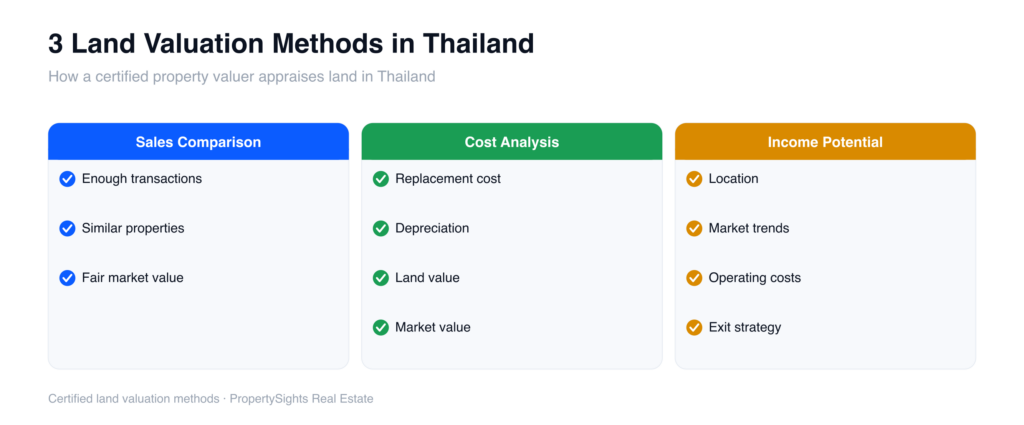
The land valuation methods used by a certified property valuer in Thailand include sales comparison of similar transactions, cost analysis, and evaluating income potential.
The Sales Comparison Method of Land Valuation
The sales comparison method of land valuation is only possible when a sufficient number of transactions have taken place in a given market, making it possible to aggregate information on similar properties. The end result is the fair market value of a given property.
Fair market value (FMV) refers to the estimated cost point at which the property can be bought and sold under normal market conditions, without any outside influence.
The Cost Analysis Method of Land Valuation
The cost analysis method of land valuation involves estimating property replacement costs and value depreciation alongside the price of the land. Here are the components of cost analysis:
- Replacement Cost: The cost to construct new structures with the same utility as the
existing property. It includes material, labor, and overhead cost. The current condition or depreciation of the property is not considered at this stage. - Depreciation: After unearthing the replacement cost, depreciation is deducted to account for the reduction in the property’s value over time due to factors like physical wear and tear or the property’s original purpose being less profitable. This could stem from changes to local or broad economic conditions.
- Land Value: After deducting the depreciation and replacement cost, the estimated value of the land is added. Land is considered non-depreciable.
- Market Value: Taking the sum of the depreciated replacement cost and the land value gives you a market value estimate on the property.
Cost analysis is used in situations where there are few market comparables. This could be the case for special buildings like schools or hospitals, but is less likely to be used for residential property.
The Income Potential Method of Land Valuation
Income potential takes into account any monetary returns that the property might generate. This is typically weighted more heavily in commercial real estate and rental properties. Here are the aspects that are carefully considered as part of a property’s income potential:
- Location: Proximity to transportation, schools, and commercial centers, including potential future developments helps to determine possible appreciation.
- Market trends: Local property values, rental income rates, and economic indicators (local and more broadly).
- Type and condition of property: Depending on the type of property and how you intend to use it, the income potential will vary. Future renovations are another consideration.
- Operating costs: Financing options, interest rates, and general operating costs.
- Exit strategy: Different options like selling for a short-term profit or holding for long-term income.
- Legal and regulation: Knowledge of local laws and regulations can help mitigate legal and financial risks.
- Environment: The risk of natural disasters or factors like humidity can affect a property’s investment potential.
What Is the Difference Between Land Appraisal Value and the Market Price?
The main difference between the land appraisal value and the market price of a piece of real estate is that Treasury Department-issued reviews are typically under-valued by comparison. Because assessors only re-calculate the property’s worth every 4 years, it can quickly get out of sync with the true market worth.
Should You Consult Our Local Expert Agents at PropertySights Real Estate?
You can consult local TREBA (Thai Real Estate Broker Association) licensed agencies like PropertySights Real Estate for a clearer picture of a property’s value via market trends and demand forces seen in property listings. They stay up to date on market conditions by using tools like sales comparisons and property assessments and have real estate consulting services that can give you an advantage in your search for property.
Get a Free Consultation with PropertySights
Would you like a free real estate consultation from our experts?
For up-to-date market conditions and help with a Thai real estate appraisal, contact PropertySights Real Estate.


